
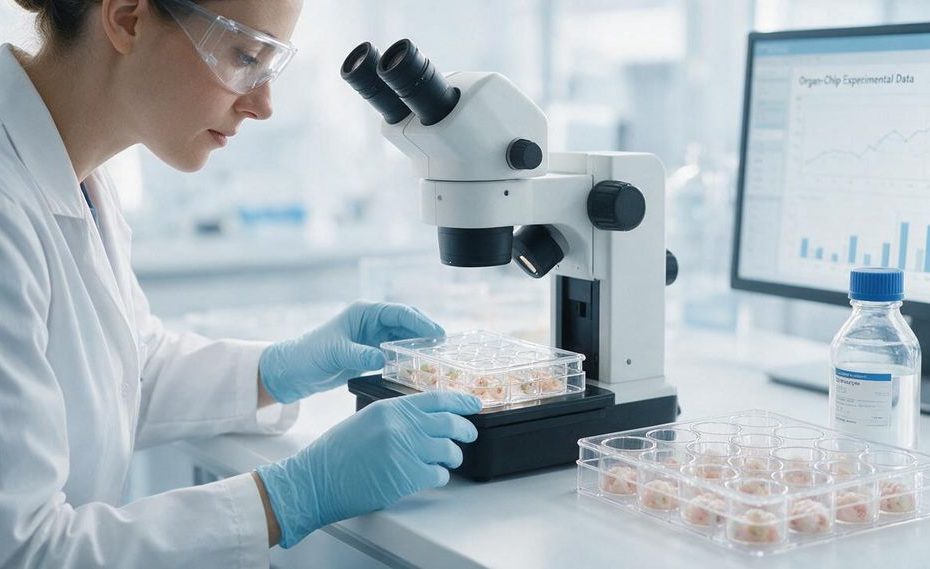
Animal-free drug testing is moving from a research goal toward routine regulatory use, but it won’t replace every animal study at once. You should expect a staged shift built around validated human-cell models, organ chips, laboratory assays, and computer simulations chosen for specific safety questions.
Policy barriers have fallen, and the United States Food and Drug Administration (FDA) now encourages drug developers to submit data from New Approach Methodologies (NAMs). Yet permission to use a method doesn’t prove that the method can answer every question regulators ask. To understand what comes next, you need to separate scientific promise from regulatory readiness, manufacturing capacity, and day-to-day laboratory reality.
What Does Animal-Free Drug Testing Actually Mean?
Animal-free drug testing uses non-animal methods to study a medicine’s activity, movement through the body, and potential safety risks before human trials. It doesn’t refer to one universal replacement test. It covers a collection of tools that generate different types of evidence.
NAMs include two-dimensional human-cell assays, three-dimensional organoids, chemical reactivity tests, organs on chips, and computer-based models. Some definitions also include studies using lower organisms, though those methods aren’t strictly animal-free. For drug developers, the useful question isn’t whether a test fits a broad label. You need to know which decision it can support and where its limits begin.
A liver model may help identify liver injury, but it won’t automatically predict effects on the immune system, heart, kidneys, or reproductive development. A computer model may estimate how a drug is absorbed and cleared, but its output depends on the quality and relevance of its source data. Animal-free testing will usually rely on several complementary methods rather than one substitute for an entire animal study.
Why Is Animal-Free Drug Testing Advancing Now?
The shift is accelerating because federal policy now permits non-animal evidence, regulators have issued clearer guidance, and human-based technologies have matured. These developments give drug sponsors more room to design nonclinical programs around the scientific question instead of defaulting to a standard animal package.
Federal law replaced older wording centered on preclinical animal tests with the broader term “nonclinical tests.” The legal definition permits cell-based assays, microphysiological systems, bioprinted models, and computer models alongside animal studies. This change removed a major statutory barrier, but it didn’t guarantee automatic regulatory acceptance for every new method.
The FDA later published a roadmap beginning with monoclonal antibodies and expanding toward other biologic products and chemical drugs. The agency has also issued draft guidance for validating NAMs and reducing some nonhuman primate studies. Animal-free drug testing now has a regulatory path, yet developers still need evidence that each proposed method is reliable and suited to its intended decision.
Which Technologies Can Replace Animal Studies?
The leading alternatives include human-derived cell systems, organoids, organs on chips, chemical assays, and computational models. Each technology captures a different part of human biology, so you need to match the method to the drug, organ, biological mechanism, and safety endpoint.
Organoids are self-organizing, three-dimensional cell cultures that reproduce selected structures and functions of human tissues. Microphysiological systems (MPS), often called organs on chips, add engineered channels, fluid flow, mechanical forces, and multiple cell types. A liver chip can model metabolism and tissue injury under controlled conditions, and a cardiac model can measure electrical or contractile effects.
Artificial Intelligence (AI) and other computer models can analyze chemical structure, predict toxicity, estimate drug exposure, and combine information from several experiments. Chemical reactivity assays can detect defined hazards without requiring a living organism. Simpler cell assays remain useful when you need rapid screening, measurable endpoints, and greater testing volume than organ-chip systems can currently provide.
Why Won’t Policy Changes End Animal Testing Immediately?
Legal permission and regulatory guidance open the door, but scientific validation determines whether a method can pass through it. A sponsor can propose an alternative test, yet the FDA still needs enough evidence to judge whether the result supports safe entry into human trials.
Traditional animal studies have established protocols, historical control data, trained personnel, and familiar reporting formats. Many NAMs are newer, vary across laboratories, and lack large reference datasets tied to known human outcomes. Replacing a familiar study requires more than showing that a new model produces interesting biological signals.
You also need to consider international development programs. A medicine intended for several markets may face different expectations from national regulators. If one authority accepts a non-animal package and another requests an animal study, the sponsor may still conduct that study to preserve access across markets. Shared standards and aligned review practices will shape the actual pace of adoption.
Why Is Validation So Difficult?
A useful NAM must perform reliably for a defined purpose, produce repeatable results, and reflect the human biology connected to the decision. Validation becomes difficult when laboratories use different cells, materials, instruments, culture conditions, software, or measurement rules.
The FDA’s draft recommendations focus on intended regulatory use, human biological relevance, technical characterization, and fitness for the decision being made. A method designed to flag potential liver injury doesn’t need to reproduce every liver function. It does need to detect the relevant hazard consistently and establish the conditions under which its predictions can be trusted.
Developers also need suitable reference drugs, including compounds known to produce a human effect and compounds known not to produce it. Testing across several laboratories can reveal whether performance depends on one operator or facility. Regulators need transparent acceptance criteria, error rates, study controls, raw data practices, and known performance boundaries before a NAM can carry greater regulatory weight.
What Technical Problems Still Limit Organs On Chips?
Organs on chips can reproduce selected features of human tissue, but they don’t reproduce an entire person. Their reliability depends on cell quality, device materials, fluid control, tissue maturity, and the biological features included in the model.
Cell sources create an immediate tradeoff. Immortalized cell lines are easier to grow and standardize, yet they may differ from normal human tissue. Primary human cells can offer greater biological relevance, but donor variation and limited expansion make consistent production harder. Cells derived from induced pluripotent stem cells can broaden supply, though differentiation and tissue maturity still require tight quality controls.
Chip materials can also change the experiment. Some materials absorb small, hydrophobic drug molecules, which lowers the amount that reaches the cultured tissue. Single-organ models may miss hormonal, immune, metabolic, and organ-to-organ interactions. Multi-organ systems can address some gaps, but they add engineering difficulty, operating costs, data volume, and more opportunities for variation.
Will Animal-Free Methods Predict Human Safety Better?
Human-based models can improve prediction when species differences make an animal model poorly suited to a drug’s mechanism. They aren’t automatically superior for every endpoint, and their value must be demonstrated against relevant human data.
Monoclonal antibodies show why method selection matters. These medicines are designed to bind specific biological targets, and animal immune responses may not predict human immune responses. The FDA’s roadmap notes that antibodies can trigger species-specific effects that alter exposure or make toxicity findings harder to interpret. Human immune-cell assays and tissue models may answer certain questions more directly.
The FDA also reports that more than 90 percent of drugs clearing animal studies don’t receive approval, often because safety or effectiveness problems emerge during human trials. That figure doesn’t mean animal tests have no value. It shows that clearing animal studies doesn’t guarantee success in humans. The best nonclinical program will compare available methods and combine evidence according to the uncertainty each test can reduce.
Which Drug Programs Are Likely To Change First?
Programs with well-defined mechanisms, strong existing human knowledge, and known weaknesses in animal relevance are positioned to change first. The FDA began with certain monoclonal antibodies rather than attempting to remove all animal tests across every drug class.
Monospecific antibodies can be suitable for streamlined programs because their targets and biological activity are often well characterized. Their large molecular size, tissue distribution, metabolism, and target specificity differ from many small-molecule drugs. These properties can allow developers to use target biology, human-cell evidence, clinical knowledge, and shorter studies to answer questions that once prompted routine long-term animal testing.
Other areas will move at different speeds. A method may replace one liver, heart, immune, or chemical safety test long before a full development program becomes animal-free. Drugs with new mechanisms, uncertain exposure patterns, several active components, or poorly understood off-target effects may require broader evidence. Progress will be measured study by study and endpoint by endpoint.
How Should Drug Developers Prepare For The Transition?
You should build NAM planning into the development program early, define the regulatory purpose of every proposed method, and discuss the plan with the relevant review division before starting major studies. Waiting until submission makes it harder to correct gaps in validation, controls, or data reporting.
Start by mapping each safety question to the evidence needed for a development decision. Review whether an established alternative method already exists, then compare its biological relevance and performance with the available animal model. If you’re developing a new assay, document cell identity, materials, operating conditions, reference compounds, acceptance limits, software versions, and data handling procedures.
You’ll also need teams that can connect biology, engineering, toxicology, statistics, quality systems, and regulatory strategy. Laboratories should measure repeatability within a site and reproducibility across sites. Sponsors should preserve traceable records for model construction, test execution, exclusions, failures, and analysis. Animal-free drug testing will advance faster when regulators can review the evidence without guessing how the method worked.
What Are The Main Barriers To Animal-Free Drug Testing?
- Method validation
- Cross-laboratory reproducibility
- Limited whole-body modeling
- Regulatory differences between markets
- Manufacturing, training, and data standards
A Practical Shift, Not An Overnight Switch
Animal-free drug testing is no longer a distant laboratory idea, but the transition will come through targeted replacements rather than one sweeping change. You’ll see human-cell assays, organoids, organs on chips, and computer models take on larger roles where they answer defined safety questions reliably. Animal studies will decline as reference data, shared standards, regulatory experience, and production capacity improve. Drug developers that define intended use early and validate methods against human-relevant outcomes will be better prepared for this shift. The destination is more human-relevant testing, but reaching it requires disciplined evidence, transparent limits, and close communication with regulators.
References
- United States Food and Drug Administration: Roadmap to Reducing Animal Testing in Preclinical Safety Studies
- United States Food and Drug Administration: General Considerations for the Use of New Approach Methodologies in Drug Development
- United States Food and Drug Administration: Monoclonal Antibodies, Streamlined Nonclinical Safety Studies
- United States Food and Drug Administration: Progress in Reducing Animal Testing in Drug Development
- United States Congress: FDA Modernization Act 2.0
- National Institute of Environmental Health Sciences: Validation and Regulatory Acceptance of Toxicological Test Methods.

Nirdosh Jagota is Managing Partner at GRQ Biotech Advisors with 30+ years in the biotech industry. A former executive at Amgen, Genentech/Roche, Merck, and Pfizer, he has led >25 NDAs/BLAs/MAAs and hundreds of INDs across global regulatory, quality, and compliance.