
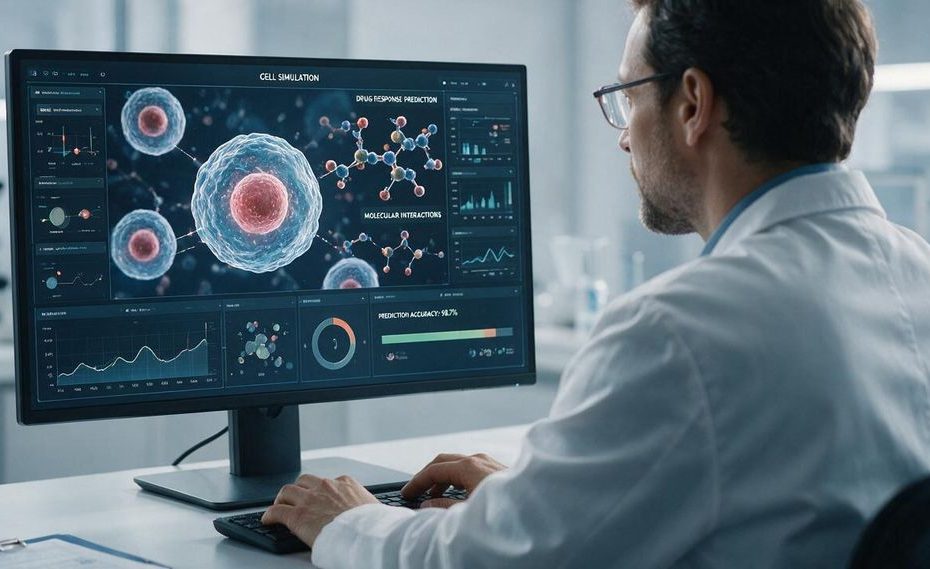
Virtual cell models can predict human-specific responses, time-dependent cell behavior, and hidden signaling effects that static cultures or animal studies may miss. They cannot replace laboratory testing, but they can help you identify weak drug candidates sooner and design more focused experiments.
A treatment can perform well in a plastic dish or an animal study, then produce an unexpected result in people. That gap often comes from species differences, simplified culture conditions, or biological feedback that a physical model does not capture. Virtual cells give you another way to examine those blind spots before moving a candidate into later testing.
Why Do Traditional Lab Models Miss Human Responses?
Traditional models miss some human responses because they simplify biology or reproduce the biology of another species. A two-dimensional cell culture isolates cells from many of the chemical, spatial, and mechanical signals they receive inside the body. Animal models preserve more biological interaction, but animal and human cells do not always process drugs in the same way.
Cells grown on flat plastic can change their shape, gene activity, metabolism, and response to stress. They also lack many neighboring cell types, physical barriers, fluid movement, and concentration gradients. Three-dimensional organoids restore part of that structure, yet they still represent a limited portion of an organ and may not reproduce whole-body interactions.
Species differences add another source of uncertainty. A drug can affect ion channels, enzymes, or signaling pathways differently across animals and humans. Virtual cell models help you explore human data directly, compare competing explanations, and identify where an animal result may not transfer cleanly to a person.
What Are Virtual Cell Models?
Virtual cell models are computer-based representations of cellular processes that simulate how a cell responds to biological conditions or treatments. They can model gene regulation, protein activity, metabolism, electrical behavior, signaling pathways, and interactions between cell structures.
Mechanistic models use known biological relationships and mathematical equations. Ordinary differential equations can describe how molecule concentrations rise or fall, stochastic models can represent random cellular events, and spatial models can track where reactions occur inside a cell. These models are often described as white-box models because you can inspect the assumptions and trace why the simulation produced a result.
Artificial Intelligence (AI) and machine learning models take a different route. They learn patterns from large experimental datasets, including single-cell measurements, images, and molecular profiles. These models can detect relationships that researchers did not encode manually, but their reasoning may be harder to interpret, which is why they are often called black-box models.
How Do Virtual Cells Reveal Hidden Biological Effects?
Virtual cells reveal hidden effects by tracking interacting pathways across time, dose levels, and cellular states. A laboratory assay may capture one measurement at one moment. A simulation can examine how an early molecular change spreads through several feedback loops and alters later cell behavior.
Cell signaling rarely follows a straight line from drug exposure to outcome. One pathway can activate another, suppress a competing signal, or trigger a compensating response hours later. If a drug blocks one route, the cell may redirect activity through another route and reduce the intended effect. A virtual model lets you test these possible chain reactions before selecting the most informative physical experiment.
Simulation also makes it easier to compare many conditions under consistent rules. You can adjust dose, exposure length, mutation status, protein abundance, or metabolic activity without rebuilding a physical assay for every variation. The output does not prove what will happen in a living system, but it helps you rank hypotheses and identify measurements that deserve closer laboratory review.
Can Virtual Cells Predict Cardiac Safety Risks?
Virtual cardiac cell models can help predict whether a drug may disrupt the electrical activity of the human heart. The United States Food and Drug Administration uses computer modeling within its cardiac safety work to improve the assessment of drug-related rhythm risks.
These models represent a human ventricular muscle cell and simulate the movement of electrically charged ions through cellular channels. Researchers can add laboratory measurements showing how a drug affects those channels, then calculate how the combined effects may alter the cell’s electrical signal. This can reveal a risk that a single-channel test or an animal study could misclassify.
The value comes from combining several forms of evidence. Laboratory assays measure direct drug effects, computer simulations estimate their combined impact on the human cardiac cell, and follow-up studies test whether the prediction holds. This method shows how in silico modeling can act as a translational bridge rather than a substitute for physical testing.
How Accurate Are Computational Models In Drug Discovery?
A computational model is only as reliable as its data, assumptions, validation methods, and intended use. Accuracy should be measured against new laboratory or clinical observations, not only against the dataset used to build the model.
A model can appear accurate when it is tested on familiar data but fail when it encounters a new cell type, mutation, dose range, or experimental method. This is the biological version of the garbage-in, garbage-out problem. Missing measurements, inconsistent laboratory protocols, biased datasets, and uncertain biological relationships can all distort a prediction.
You should also judge accuracy according to the decision the model supports. A model designed to rank drug candidates does not need to recreate every process inside a cell. It needs to separate stronger candidates from weaker ones at a useful and repeatable rate. A model used to estimate toxicity requires stricter validation because an incorrect result can hide a safety concern or eliminate a viable treatment.
Can Virtual Cells Replace Wet Labs And Animal Models?
Virtual cells cannot replace wet laboratories or animal models across drug development. They are best used to reduce unproductive testing, refine experimental plans, and show where physical evidence is still needed.
A simulation does not create new biological evidence on its own. It reorganizes existing knowledge and data into a form that can generate predictions. Researchers still need cell cultures, organoids, organ-on-a-chip systems, animal studies, and human data to build, test, and update the model.
The practical benefit is better experimental selection. Instead of screening every possible dose or molecular combination in the laboratory, you can use simulation to narrow the search. You can then test the most informative conditions, compare the results with the prediction, and revise the model when biology behaves differently.
What Is The Difference Between Mechanistic Models And Machine Learning?
Mechanistic models explain behavior through known biological rules, and machine learning models predict behavior by finding patterns in data. Your choice depends on whether you need an interpretable explanation, predictive performance, or a combination of the two.
A mechanistic model may represent a signaling pathway as a set of reactions and equations. You can change one reaction rate, follow its effect through the pathway, and connect the output to a biological cause. This makes mechanistic modeling useful for testing causal hypotheses and identifying gaps in current knowledge.
Machine learning works well when you have large datasets containing many variables. It can connect gene expression patterns, cell images, protein measurements, and treatment outcomes without requiring every relationship to be programmed in advance. Hybrid models combine learned patterns with biological rules, helping you gain predictive reach without giving up every form of interpretability.
How Could Digital Twins Improve Virtual Cell Models?
A cellular digital twin is a virtual model designed to represent a particular cell state, disease profile, or biological system using measured data. New measurements can update the model so its predictions stay aligned with the system being studied.
Single-cell biology is expanding the amount of data available for these models. Researchers can measure differences between cells that appear similar under a microscope, then use those differences to predict distinct treatment responses. The Chan Zuckerberg Initiative supports AI-powered virtual cell research aimed at helping scientists examine molecular processes associated with health and disease.
The strongest future systems will connect several biological levels. A cell model can feed into tissue simulations, organ-on-a-chip experiments, and models of drug movement through the body. That integration can help you trace how a molecular change inside one cell contributes to a tissue-level response, then identify the physical experiment needed to confirm it.
How Can Virtual Cells Improve Drug Testing Accuracy?
- Predict human-specific toxicity earlier
- Simulate long-term cell behavior quickly
- Identify hidden signaling feedback loops
- Reduce false positives in early screening
Where Virtual Cells Deliver The Most Value
Virtual cell models give you a structured way to examine biological behavior that a static assay or nonhuman model may overlook. Their strongest use is not replacing physical research, but connecting scattered measurements, testing causal explanations, and choosing better experiments. Mechanistic simulation provides traceable reasoning, machine learning finds patterns across large datasets, and hybrid models combine those strengths. When predictions are tested against independent evidence and updated after failure, virtual cells can reduce wasted screening and expose human-specific risks earlier. The wet lab remains the source of biological proof, but simulation helps you ask sharper questions before committing time and resources.
References
- Chan Zuckerberg Initiative: Virtual Cells
- United States Food and Drug Administration: Cardiac Safety Modeling Initiative
- National Center for Multiscale Modeling of Biological Systems
- Nature Methods: Computational Models
- University of Connecticut Health: Virtual Cell Project.

Nirdosh Jagota is Managing Partner at GRQ Biotech Advisors with 30+ years in the biotech industry. A former executive at Amgen, Genentech/Roche, Merck, and Pfizer, he has led >25 NDAs/BLAs/MAAs and hundreds of INDs across global regulatory, quality, and compliance.