
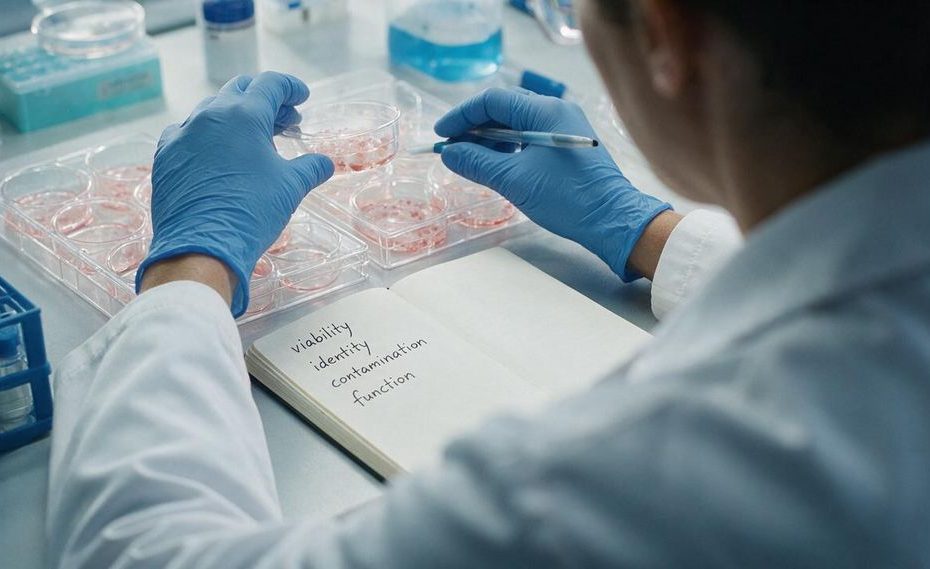
Successful mammalian cell culture means maintaining cells that are alive, correctly identified, free from contamination, fit for their intended use, and consistent enough to support dependable results. Viability is an entry requirement, not proof that a culture is performing as intended.
You need to assess what the cells are doing, how their behavior is changing, and whether the culture still represents the biological system you selected. That means monitoring identity, morphology, growth, passage history, purity, function, and process conditions alongside viability.
What Does “Alive” Actually Tell You?
A viability result tells you that cells meet the chosen assay’s definition of living at a particular time. It doesn’t confirm identity, normal function, expected growth, or experimental suitability.
Different viability methods measure different biological properties. Dye-exclusion tests assess membrane integrity, whereas metabolic assays may detect enzyme activity or adenosine triphosphate (ATP). A strong metabolic signal can reflect changes in activity per cell rather than a direct increase in cell number. You need to understand what the assay measures before treating its output as proof of culture quality.
Viability also compresses a mixed population into a single percentage or signal. A culture can contain stressed cells, slow-growing cells, altered subpopulations, and healthy cells at the same time. Two cultures with matching viability can differ in doubling time, attachment, morphology, response to treatment, or protein production. Pair viability with measurements linked to the intended application.
How Do You Know the Cells Are the Right Cells?
You confirm cell identity through authentication, traceable records, and controlled handling. Appearance under a microscope can support routine monitoring, but it can’t prove identity.
Cross-contamination, mislabeling, and handling errors can leave you working with a healthy culture that isn’t the cell line named on the vessel. The National Institute of Standards and Technology notes that inadvertent mixing or misidentification may not be visible through routine microscopy. Human cell lines are commonly authenticated through short tandem repeat (STR) profiling, which examines defined deoxyribonucleic acid (DNA) markers. Authentication methods for nonhuman cell lines depend on the species and available validated tests.
Build identity checks into the life of the culture rather than treating authentication as a one-time event. Authenticate newly received cells, create traceable master and working stocks, and repeat testing after events that increase risk. These events include unexplained changes, suspected cross-contamination, prolonged culture, and transfer between laboratories. Labeling standards and controlled records protect identity between formal tests.
Why Can Healthy-Looking Cultures Still Produce Bad Data?
Cells can remain attached, divide, and look normal even when hidden contamination or biological drift has changed their behavior. Visual health is useful evidence, but it isn’t enough to establish purity or function.
Mycoplasma is a major reason cultures can appear normal yet become unreliable. It may not produce the turbidity or obvious visual changes associated with many bacterial and fungal contaminants. It can alter cell proliferation, metabolism, gene expression, membrane properties, transfection performance, and other cellular functions. Routine testing is the dependable way to detect it.
Standard antibiotics don’t provide reliable protection against mycoplasma and can suppress visible signs of other contamination. Quarantine incoming cultures until testing confirms their status, and separate questionable material from established clean stocks. Review cabinet practices, incubator maintenance, shared reagents, pipetting technique, and personnel movement when contamination appears. A negative test has limited value if poor handling allows the culture to become contaminated soon afterward.
Which Culture Conditions Need Tight Control?
You need to control the conditions that influence cell growth, stress, metabolism, and function. The relevant variables include medium composition, supplements, temperature, potential of hydrogen (pH), carbon dioxide (CO2), osmolality, seeding density, surface properties, and feeding schedule.
Small operational changes can become biological changes. A different serum lot, delayed medium change, altered vessel coating, or longer period outside the incubator can affect cellular behavior. Seeding density deserves particular attention because cell-to-cell contact and nutrient availability can influence proliferation, differentiation, and treatment response. Record these conditions in enough detail to repeat them.
Set operating ranges from observed cell performance rather than habit. Track incubator readings, medium preparation, reagent lots, culture duration, cell density, and deviations from the approved procedure. In a bioreactor, monitoring may expand to dissolved gases, agitation, mixing, nutrient use, waste accumulation, productivity, and product quality. Stable conditions make unusual cell behavior easier to investigate.
How Do Passage Number And Growth Phase Change Cell Behavior?
Repeated passaging can alter morphology, growth rate, gene or protein expression, transfection efficiency, and response to stimuli. Growth phase also affects experimental performance, so passage history alone doesn’t describe the culture’s condition.
Passage number records how many times cells have been transferred, but it doesn’t always show how many population doublings have occurred. Split ratios, cell loss, recovery after thawing, and time between passages can differ across laboratories. Record passage number alongside seeding density, harvest density, culture duration, and population doubling information when relevant. This creates a clearer account of the cells’ history.
Create an acceptable passage range using measurements tied to your work. Compare morphology, proliferation, marker expression, functional output, and treatment response across that range. Cells should generally be subcultured during active exponential growth rather than after extended crowding or nutrient depletion. Return to a tested low-passage working stock when performance moves outside established limits.
What Should You Measure Beyond Viability?
Measure attributes that show whether the culture is authentic, pure, stable, and capable of performing the required biological task. The exact panel depends on whether you’re running an assay, studying a cellular mechanism, maintaining primary cells, or producing a biological material.
Routine monitoring can include morphology, viable cell concentration, total cell concentration, confluence, attachment, doubling time, recovery after thawing, and contamination status. Application-specific checks may include marker expression, differentiation state, response to a control treatment, transfection efficiency, secretion, or product yield. A reference image and an expected growth curve can reveal gradual changes that a single viability result misses. Trend data are often more useful than isolated measurements.
Choose more than one measurement when one assay could give an incomplete answer. Metabolic viability data can be compared with direct cell counts, imaging, membrane-integrity tests, or a functional readout. Controls should confirm that the assay responds when cell condition improves or declines. Acceptance limits should reflect the decision you need to make, not an arbitrary preference for perfect-looking numbers.
How Do You Build Reproducible Mammalian Cell Culture?
Reproducible mammalian cell culture depends on defined procedures, qualified cell stocks, trained handling, suitable controls, and records that explain how every experimental culture was produced. Consistency must be designed into daily work.
Start with an authenticated, contamination-tested stock and create a banking system that limits time in continuous culture. Define thawing, recovery, feeding, passaging, counting, and freezing procedures. Specify acceptable ranges for passage number, confluence, viability, morphology, and growth where those measures apply. Use the same decision rules across operators so culture timing doesn’t depend on personal judgment alone.
Review trends rather than waiting for outright failure. A gradual increase in doubling time, weaker attachment, altered morphology, or falling productivity can signal trouble before viability collapses. Document deviations, investigate their cause, and compare the culture with a qualified reference stock. Reproducibility comes from controlling cell history and measurement practices as carefully as the experimental treatment.
What Is A Practical Mammalian Cell Culture Quality Checklist?
- Confirm identity and traceability.
- Test routinely for contamination.
- Track passage, growth, and morphology.
- Control media and incubator conditions.
- Measure function, not viability alone.
Make Fitness For Purpose The Real Goal
Keeping cells alive proves that the culture has passed only its first test. You still need to know whether the cells are the correct type, free from hidden contamination, within an acceptable culture age, growing predictably, and performing the function your work requires. Authentication protects identity, routine testing protects purity, and trend monitoring helps you detect drift. Defined operating ranges make results easier to compare across experiments, operators, and sites. Good mammalian cell culture ends with cells that are fit for purpose, not merely alive.
References
- ATCC Animal Cell Culture Guide
- ATCC Passage Number Effects in Cell Lines
- ATCC Mycoplasma Contamination
- National Institute of Standards and Technology Cell Line Authentication
- National Institute of Standards and Technology Cell Characterization
- National Center for Advancing Translational Sciences Cell Viability Assays
- Food and Drug Administration Cell Culture Process Guidance.

Nirdosh Jagota is Managing Partner at GRQ Biotech Advisors with 30+ years in the biotech industry. A former executive at Amgen, Genentech/Roche, Merck, and Pfizer, he has led >25 NDAs/BLAs/MAAs and hundreds of INDs across global regulatory, quality, and compliance.