
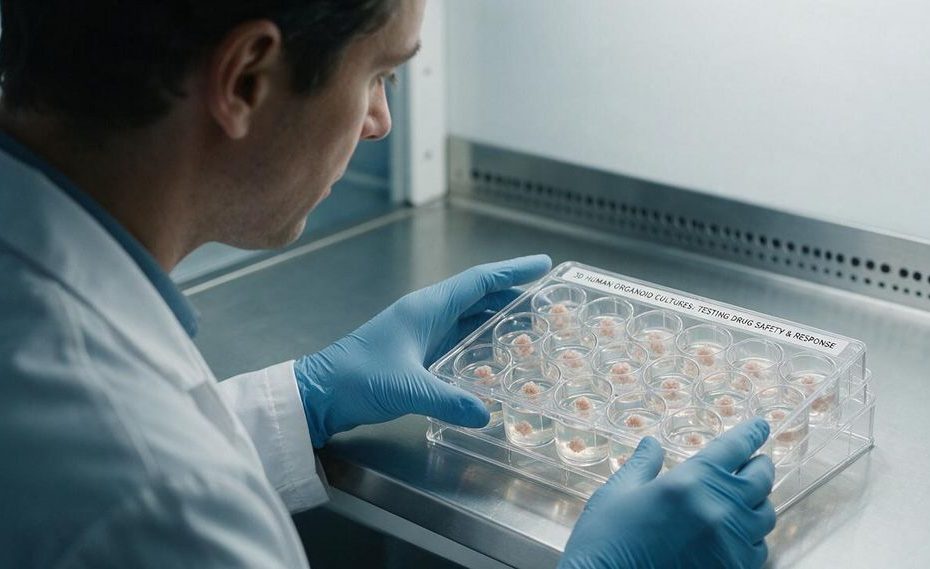
Organoids in drug development are becoming more useful because they give you a three-dimensional, human-relevant model that sits between simplified cell cultures and human clinical trials. They can reproduce selected structural and functional features of human organs, helping research teams assess drug activity and safety before exposing trial participants to a candidate.
Drug development carries a high failure rate partly because preclinical findings don’t always translate to people. Organoids give you another way to study human biology alongside animal models, organ-on-a-chip systems, computer models, and traditional laboratory cultures.
To understand their growing value, you need to examine what organoids reproduce, where they improve testing, how they support patient-specific screening, and which technical limits still affect their use.
What Are Organoids, And How Do They Differ From Traditional Cell Cultures?
Organoids are self-organizing, three-dimensional (3D) cell cultures grown from pluripotent stem cells or adult tissue stem cells. They can reproduce selected features of an organ’s structure, cell composition, and function more closely than conventional two-dimensional (2D) cultures.
In a 2D culture, cells usually grow across a flat surface. That arrangement makes the cells accessible and relatively easy to measure, but it changes how they interact with neighboring cells, extracellular material, nutrients, and chemical signals. A drug response observed under these conditions may not represent how the same cells behave inside human tissue. Organoids place cells in a spatial arrangement that better reflects tissue organization.
You should also distinguish organoids from spheroids. Spheroids are 3D clusters of cells, but they don’t always reproduce the organized cell types and functions associated with organoids. Organoids usually rely on stem cells that differentiate and self-organize under controlled culture conditions. Their value comes from this added biological organization, not from shape alone.
Why Do Traditional Models Leave A Translational Gap?
Traditional models leave a translational gap because findings from flat cell cultures and animals don’t always predict human efficacy or toxicity. Organoids can narrow that gap by letting you test candidates in tissue made from human cells before clinical trials begin.
Animal models remain useful for studying interactions across a whole living system, including metabolism, circulation, and responses involving several organs. Yet biological differences between species can change how a compound is absorbed, processed, or tolerated. According to the National Center for Advancing Translational Sciences, about 30% of promising drugs fail in human clinical trials after being found toxic, even after favorable animal studies. That figure shows why drug developers need additional preclinical tools rather than relying on a single model.
Organoids don’t reproduce an entire human body, so you can’t treat them as direct substitutes for clinical evidence. Their strength lies in answering focused questions about a tissue, disease process, or patient population. When you combine organoid data with animal studies, computational analysis, and other laboratory methods, you can build a more informative evidence package. This may help research teams identify weak candidates before committing greater time and resources.
How Do Organoids Improve Toxicity And Safety Screening?
Organoids improve safety screening by exposing human-like tissue to drug candidates under controlled laboratory conditions. You can then measure tissue damage, functional changes, dose responses, and other warning signals that may be missed in simpler cultures.
Liver organoids are relevant because the liver processes many drugs and can be vulnerable to drug-induced injury. Kidney organoids can help researchers examine effects on renal cell types, and intestinal organoids can reveal changes in barrier function or tissue response. These models let you investigate toxicity within the organ most likely to experience harm. You can also compare several concentrations to identify the point at which beneficial activity gives way to tissue damage.
Earlier toxicity detection can improve candidate selection. If an organoid test repeatedly shows harmful effects in human-derived tissue, you can review the compound’s dose, chemistry, delivery method, or development priority before advancing it. A negative organoid result doesn’t prove that a candidate is unsafe in people, just as a favorable result doesn’t guarantee safety. It gives you another human-relevant signal to compare with data from other preclinical methods.
How Are Patient-Derived Organoids Used For Drug Selection?
Patient-derived organoids are grown from cells collected from an individual’s tissue, allowing you to test treatments against a laboratory model that retains selected features of that person’s biology. They are especially useful for cancer research, disease modeling, biomarker discovery, and personalized drug screening.
Tumor organoids can preserve important characteristics of the original tumor, including its cell organization and selected molecular features. Researchers can expose these organoids to several drug candidates or combinations and compare how strongly the tissue responds. This creates a controlled way to examine why a treatment works against one tumor sample but has limited activity against another. It can also support the search for biomarkers associated with response or resistance.
Patient-derived models come with practical constraints. Generating them may take weeks or months, and some samples don’t grow reliably under laboratory conditions. Tissue quality, culture media, collection methods, and technical skill can affect the result. If you’re considering these models for treatment selection, you need validated procedures and realistic timelines that fit the decision being made.
How Are Organoids Scaled For High-Throughput Drug Screening?
Organoids can support high-throughput drug screening when research teams standardize their size, growth conditions, handling, and measurement methods. Automation then allows you to test many compounds, doses, or combinations across multiwell plates with less manual work.
Scaling is harder than simply growing more cultures. Organoids can differ in shape, cell composition, maturity, and growth rate, creating variation between wells and production batches. Automated liquid handling, imaging, and data analysis can reduce operator-dependent differences. Defined culture materials and quality controls also help you compare results across experiments.
Organoid biobanks extend this capability by maintaining models from multiple patients, diseases, or tissue types. You can screen a candidate across a varied collection rather than drawing conclusions from one cell line. This supports drug repurposing, patient subgroup analysis, and the identification of response patterns. The usefulness of a biobank still depends on reliable clinical information, sample quality, and consistent culture methods.
Can Organoids Replace Animal Testing In Drug Development?
Organoids can reduce reliance on some animal studies, but they can’t yet replace every animal model used in drug development. They lack many whole-body interactions needed to assess circulation, metabolism, immune responses, and effects across several organs.
The United States Food and Drug Administration (FDA) Modernization Act 2.0, signed into law in December 2022, removed the federal requirement that every new drug must undergo animal testing before human trials. The law allows developers to use non-animal methods, including organoids, organ-on-a-chip systems, and computer models, when appropriate. It doesn’t mean organoid evidence automatically satisfies every regulatory question. Developers still need to show that the chosen method is suitable, reproducible, and relevant to the proposed drug.
The FDA also supports work on new approach methodologies and complex in vitro models. Regulatory acceptance depends on the purpose of the test, the organoid’s validation, and the reliability of its measurements. If you plan to use organoid data in a regulatory submission, early communication with the relevant agency can clarify expectations. You should define what the model measures, how it performs, and where its limits begin.
What Limits Organoids, And What Comes Next?
The main limitations of organoids include missing blood vessels, immune cells, stromal tissue, consistent maturation, and standardized production methods. Research is addressing these gaps through co-culture methods, microfluidic engineering, better culture materials, and stronger quality controls.
Many organoids reproduce only part of an organ rather than its full architecture and function. Without vasculature, larger models may receive uneven oxygen and nutrients. Missing immune and stromal components can also reduce their value for studying inflammation, tissue repair, or interactions around a tumor. Batch-to-batch variation makes comparisons harder when laboratories use different protocols, materials, or measurement criteria.
Organoid and organ-on-a-chip technologies can complement one another. Microphysiological systems add fluid flow, mechanical signals, and tissue interfaces that static cultures may lack. Combining these tools can help you study how drugs move through tissue or affect connected organ models. Wider adoption will depend on reproducible manufacturing, practical costs, trained staff, scalable analysis, and evidence that organoid results predict outcomes that matter in development.
Why Are Organoids Useful In Drug Development?
- Predict human-specific drug responses better than many simple models
- Enable patient-derived models for personalized screening
- Support high-throughput testing of many compounds
- Help identify toxicity earlier in development
Where Organoids Fit In Better Drug Development Decisions
Organoids are most valuable when you use them to answer defined biological questions rather than expecting them to reproduce an entire human system. They can improve tissue-specific toxicity testing, disease modeling, patient-derived screening, and compound comparison. Their growing use also reflects a broader move toward human-relevant methods that complement established preclinical testing. As standardization, automation, vascularization, and immune-cell integration improve, organoids in drug development should become easier to validate and apply. The practical goal is better evidence earlier, so you can advance stronger candidates and identify avoidable problems before clinical trials.
References
- Nature Reviews Molecular Cell Biology: Organoids and Their Applications
- National Center for Advancing Translational Sciences: Tissue Chip for Drug Screening
- United States Food and Drug Administration: Advancing Alternative Methods
- Congress.gov: FDA Modernization Act 2.0
- PubMed: Organoids in Drug Development Research.

Nirdosh Jagota is Managing Partner at GRQ Biotech Advisors with 30+ years in the biotech industry. A former executive at Amgen, Genentech/Roche, Merck, and Pfizer, he has led >25 NDAs/BLAs/MAAs and hundreds of INDs across global regulatory, quality, and compliance.