
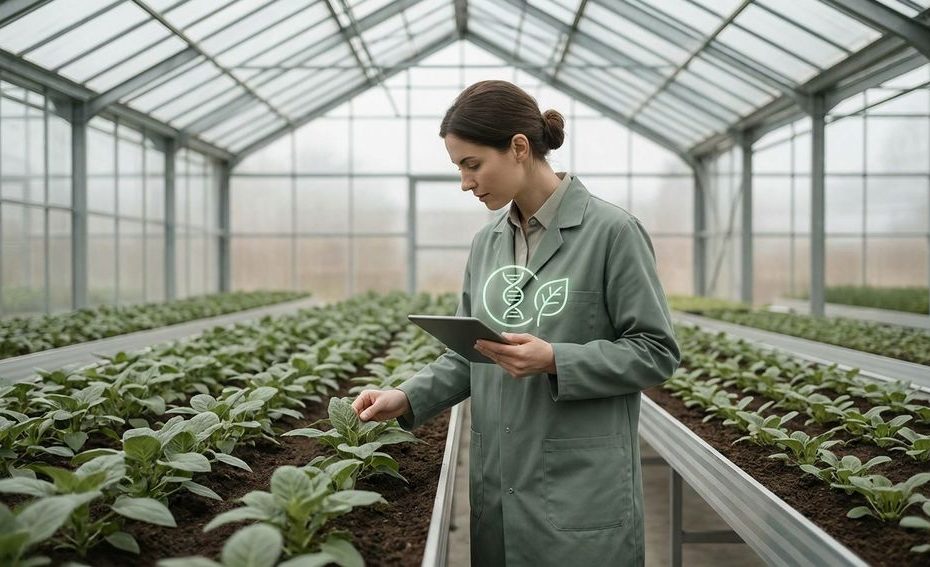
Non-medical gene editing is likely to produce the next widely visible breakthrough because it can reach farms, food systems, factories, and conservation work faster than many clinical treatments. The product that changes daily life may arrive as a crop trait, a bio-based ingredient, or an environmental tool rather than a hospital therapy.
Mention clustered regularly interspaced short palindromic repeats (CRISPR), and many people still picture rare-disease medicine. That focus makes sense, but it misses where commercial momentum is already building. This article explains where gene editing is moving outside medicine, why those uses can advance faster, and what you should watch before calling any of them a true breakthrough.
Why Does Gene Editing Still Make People Think Of Medicine First?
Gene editing still makes people think of medicine because clinical uses are easier to understand emotionally: a patient, a disease, and a possible treatment. That story is direct, personal, and often covered before agricultural biotechnology or industrial biology enters the conversation.
Medical gene editing also gets public attention because the stakes feel immediate. You can picture a therapy meant to correct a harmful genetic change in a person. By contrast, editing a plant for heat tolerance, changing a microbe to produce a dairy protein, or altering an insect population requires more explanation. The benefit is often distributed across a food supply chain, a manufacturing process, or an ecosystem.
That doesn’t make non-medical work less important. It means you need to look beyond the headline use of CRISPR. Outside the clinic, gene editing can affect what you eat, what farmers plant, what materials companies make, and how conservation groups think about species loss. The next breakthrough may be less dramatic on day one, but it could touch far more people through everyday systems.
What Does Non-Medical Gene Editing Include?
Non-medical gene editing includes food crops, livestock traits, bio-based materials, industrial microbes, conservation tools, and environmental applications. It’s the use of gene editing to change living systems outside direct human treatment.
In agriculture, that can mean crops with altered taste, nutrition, shelf life, disease resistance, or stress tolerance. In animal agriculture, it can mean traits linked to heat tolerance or disease resistance. In manufacturing, edited microbes can help produce proteins, fibers, chemicals, and ingredients through precision fermentation. In conservation, gene editing can support genetic rescue research or experimental tools aimed at invasive species and disease vectors.
You should also separate gene editing from older genetically modified organism (GMO) methods. A GMO often involves adding genetic material from another organism. Gene editing can make a targeted change within an organism’s own deoxyribonucleic acid (DNA), sometimes resembling a change that could occur through breeding. Regulators do not treat every edited organism the same way, so the specific edit, organism, and intended use matter.
Why Can Non-Medical Gene Editing Move Faster Than Medicine?
Non-medical gene editing can move faster because many products do not need to pass the same human clinical testing route required for medicines. Crops, microbes, materials, and some animal traits face their own safety reviews, but the path can be shorter when the risk profile is lower.
In the United States, the United States Department of Agriculture (USDA) allows some gene-edited plants to move forward without premarket regulatory review when the change could have been achieved through conventional breeding and no plant pest concern is introduced. That matters because a plant trait can move toward commercialization without the long drug-development process. The review question shifts from “Can this treat a patient safely?” to “Does this product trigger plant biotechnology oversight?”
That difference doesn’t mean the path is easy. Food safety, environmental impact, labeling, export rules, and public acceptance still shape whether a product succeeds. The European Union (EU) has been working through proposed rules for certain organisms created with newer genomic techniques, and that uncertainty affects companies planning international trade. Faster does not mean friction-free.
Which Gene-Edited Foods Are Already Reaching Consumers?
Gene-edited foods are already reaching consumers, though many people haven’t noticed them. The early products are less about science fiction and more about taste, nutrition, farming traits, and supply-chain practicality.
In Japan, Sanatech Seed’s Sicilian Rouge High GABA tomato became a visible direct-to-consumer gene-edited food, developed to increase gamma-aminobutyric acid (GABA) content. In the United States, Pairwise launched CRISPR-edited mustard greens under the Conscious Greens brand, marketed for reduced bitterness. These examples show why food may produce a public-facing CRISPR breakthrough before many people expect it.
Animal agriculture is also moving, though with a different review path. The Food and Drug Administration (FDA) issued a low-risk determination for Acceligen’s genome-edited beef cattle with slick hair coats linked to heat tolerance. That kind of trait points to a practical reason agriculture is interested in editing: hotter conditions, animal welfare pressures, disease risks, and the need to produce food with fewer losses. The breakthrough may look ordinary on a plate, but the production problem behind it is not ordinary at all.
How Could Gene Editing Change Fuels, Materials, And Manufacturing?
Gene editing could change manufacturing by turning microbes into programmable production systems. Instead of extracting every ingredient from animals, plants, or petrochemicals, companies can engineer organisms to produce selected proteins, fibers, and chemicals in fermentation tanks.
Precision fermentation already sits close to this idea. Companies in this area use microbial engineering to make animal-free dairy proteins, collagen-like ingredients, spider-silk-inspired fibers, and other bio-based materials. CRISPR helps researchers adjust microbial pathways with greater speed and control than older trial-and-error methods. That can shorten product development and improve yield, which matters when a lab process has to become a commercial process.
The hard part is scale. A product that works in a lab flask still has to perform in large tanks, meet purity standards, compete on cost, and fit into existing manufacturing systems. Biofuels and bioplastics face the same pressure: the biology has to work, the inputs must be affordable, and the final product has to beat or match established alternatives. Gene editing helps build the organism, but engineering, logistics, and pricing decide whether the product reaches the market.
Why Are Gene Drives And Conservation So Contested?
Gene drives and conservation uses are contested because they can affect wild populations rather than a contained product. The promise is large, but the ecological and governance questions are also large.
A gene drive is designed to spread a genetic trait through a population at a rate higher than normal inheritance. Researchers working on gene-drive mosquitoes aim to reduce the ability of certain mosquitoes to transmit disease. Groups including Target Malaria are studying this area, but open environmental release of a gene-drive organism remains a major line that has not been crossed under mainstream approved deployment. That caution is part of the story.
Conservation gene editing raises a different set of questions. Organizations including Revive & Restore work on genetic rescue ideas, and Colossal Biosciences has drawn attention to de-extinction-related goals. You should treat these efforts as early-stage or research-driven unless a source verifies field deployment and measurable results. The most useful way to judge conservation claims is to ask what organism is being edited, where it would live, who approves release, and how ecological monitoring would work.
What Could Slow The Next Breakthrough Outside Medicine?
The next breakthrough outside medicine could be slowed by scale, cost, intellectual property (IP), regulation, environmental risk, and public trust. A successful edit is only one step; the product has to survive real-world use.
Scale is often the least glamorous barrier and one of the toughest. Crops must perform across seasons, soils, pests, and weather. Fermentation products must maintain quality at commercial volume. Edited animals require breeding systems, food-supply acceptance, and clear regulatory handling. A technology can be scientifically sound and still fail if it costs too much or fits poorly into current production.
Trust may be just as important as performance. Many consumers still group gene-edited food with older GMO debates, even when the underlying change differs. Labeling, plain-language communication, independent review, and transparent risk assessment can reduce confusion. Without trust, even a useful product can stall before it earns a place in the market.
Where Is The Next Visible Breakthrough Most Likely To Land?
The next visible breakthrough is most likely to land in agriculture or biomanufacturing before conservation. Those fields offer clearer product boundaries, shorter feedback loops, and more direct paths to consumer or industrial use.
Gene-edited food has the advantage of visibility. You can taste a less bitter green, buy a nutrition-focused tomato, or hear about livestock better suited to heat. Agriculture also faces pressure from heat, disease, water stress, and food-security needs. That pressure creates demand for traits that are practical rather than flashy.
Biomanufacturing may be less visible to consumers, but it could change supply chains faster. If an edited microbe can produce a useful protein, fiber, or ingredient at the right cost, the final product may appear inside foods, cosmetics, textiles, or packaging. Conservation tools may matter deeply, but environmental release raises harder approval and monitoring questions. For now, farms and fermentation tanks look like the places where non-medical gene editing can prove itself first.
What Are The Main Non-Medical Uses Of Gene Editing?
- climate-resilient and nutrition-enhanced crops
- disease-resistant livestock
- bioengineered fuels, chemicals, and materials
- conservation tools including gene drives
What To Watch Before Calling It A Breakthrough
A real breakthrough outside medicine won’t be just a clever edit; it will be a product or tool that works safely, scales economically, and earns public confidence. Watch agriculture first, especially traits tied to climate stress, food quality, and animal health. Watch biomanufacturing closely, because edited microbes can turn biology into a production platform for ingredients and materials. Treat gene drives and de-extinction claims with more caution, since environmental release and long-term monitoring set a higher bar. Non-medical gene editing is no longer a side story, and the clearest sign of progress may be a product you use before you ever think to call it CRISPR.
References
- United States Department of Agriculture Animal and Plant Health Inspection Service Biotechnology Regulatory Services
- Food and Drug Administration Animal Veterinary Biotechnology Products
- Sanatech Seed
- Pairwise
- Target Malaria
- Revive & Restore
- European Commission New Genomic Techniques
- Nature News & Comment
- Science
- World Economic Forum.

Nirdosh Jagota is Managing Partner at GRQ Biotech Advisors with 30+ years in the biotech industry. A former executive at Amgen, Genentech/Roche, Merck, and Pfizer, he has led >25 NDAs/BLAs/MAAs and hundreds of INDs across global regulatory, quality, and compliance.